
The World Was Never Built for Your Focus. It Was Built to Steal It.
Why your focus keeps slipping isn't a willpower problem — it's a design problem. Here's the real reason, and the system that actually fixes it.
6/29/20266 min read
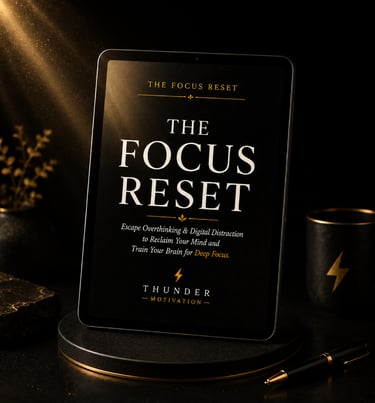
You just read why your focus keeps slipping — now here's the system to actually fix it.
The Focus Reset breaks down exactly how to escape overthinking, beat digital distraction, and retrain your brain for deep, lasting focus. No fluff, no willpower required — just a practical reset you can start today.
And it comes with A Bonus: the 21-Day Focus Reset Challenge, so you don't just read it — you actually live it.
You sit down to work. Two minutes in, your phone buzzes. You check it "just for a second." Forty minutes later, you're three apps deep, and the thing you actually meant to do is still sitting there, untouched, waiting for a version of you that apparently isn't showing up today.
If this sounds familiar, here's the truth nobody tells you: this isn't a willpower problem. It's a design problem.
And once you understand the difference, everything about how you fight back changes.
Every notification, every autoplay, every infinite scroll was engineered by teams of people whose entire job is to keep your eyes on a screen for one more minute. Your attention isn't taken from you by accident — it's the product being sold. The longer you stay distracted, the more money changes hands somewhere far away from you. You were never the customer in that exchange. You were the inventory.
This is worth sitting with for a second, because it reframes the entire problem. You didn't fail to build discipline. You're not "addicted" in some personal, moral-failing sense. You're a single person with a finite attention span, going up against systems specifically engineered — by behavioral scientists, by data on millions of other distracted people, by constant testing and refinement — to be more compelling than whatever you were trying to do instead.
That's not a fair fight. It was never supposed to be.
What a Real System Looks Like




Distraction Isn't an Accident — It's the Business Model


Why "Just Focus Harder" Doesn't Work
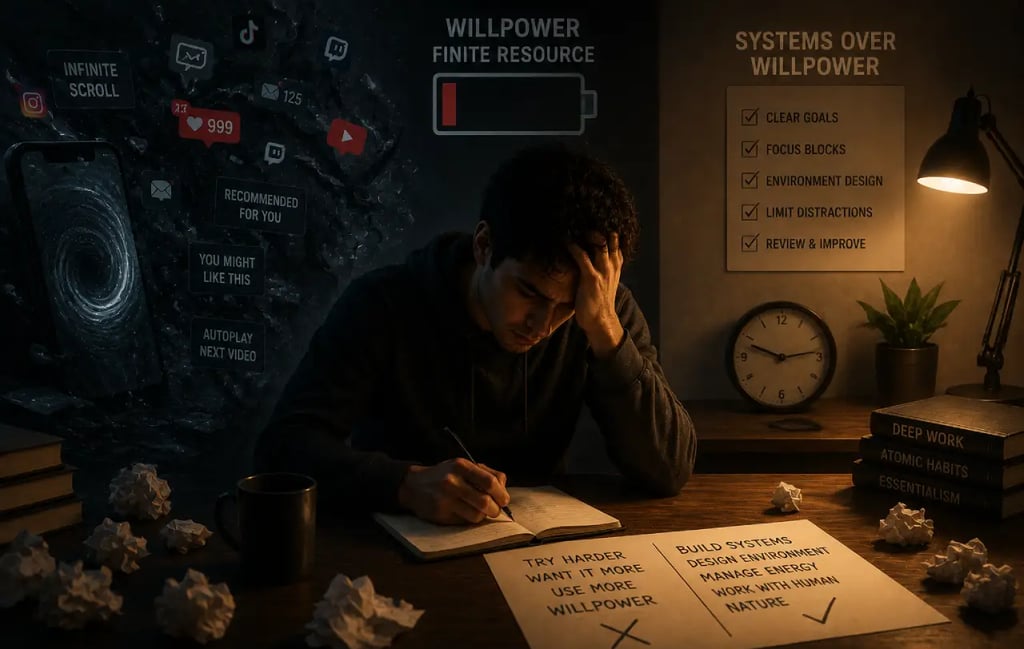
Most advice about focus sounds like this: try harder. Want it more. Use more willpower. Delete the app and just be stronger next time.
The problem is that willpower is a finite resource, not an infinite one. You can spend it down over the course of a day, the same way you spend energy or patience. And the systems you're fighting against don't get tired. They don't run out of new ways to pull your attention. They don't take a day off. So every time you rely purely on willpower to win, you're betting a depleting resource against something that has none of the same limits.
This is why the same person who feels disciplined and sharp in the morning can feel completely unable to resist a notification by 9 PM. It's not that they became a worse person over the course of the day. It's that their reserve ran out, and the thing they were fighting against never had one to begin with.
Once you see this clearly, "just try harder" stops sounding like advice and starts sounding like exactly what it is: a strategy designed to fail, dressed up as motivation.
The Real Cost of Chronic Distraction


It's easy to think of a lost afternoon as a small thing. A wasted hour here, a scattered morning there. But the actual cost of chronic distraction isn't measured in single afternoons — it's measured in the gap between who you could have become and who you're slowly becoming instead.
Every unfinished project is a small piece of evidence your brain quietly collects about who you are. Every abandoned goal — the course you didn't complete, the business idea you never launched, the book you never finished writing — adds up into a story you start to believe about yourself: I'm just not someone who finishes things.
That story isn't true. But it feels true, because it's built from a hundred small moments of losing the same fight in the same way, without ever realizing it was a fight you were never equipped to win in the first place.
This is the actual damage distraction does. Not just lost time — a lost sense of who you're capable of being.
You're Not Lazy. You're Untrained.


Here's the shift that changes everything: you don't have a focus problem. You have an untrained attention. Those are two very different situations, and they call for two very different solutions.
A focus problem implies something is broken in you — that you're missing some trait other people have and you don't. An untrained attention implies something much more solvable: you've simply never been taught how to operate in a world that's actively working against your concentration. No one sat you down and explained that the same brain you're using to "just power through" was never built for an environment with infinite novelty available in your pocket at all times.
That's not a character flaw. That's a skills gap. And skills gaps close with training, not shame.
The Shift That Changes Everything
So if willpower alone doesn't work, what does?
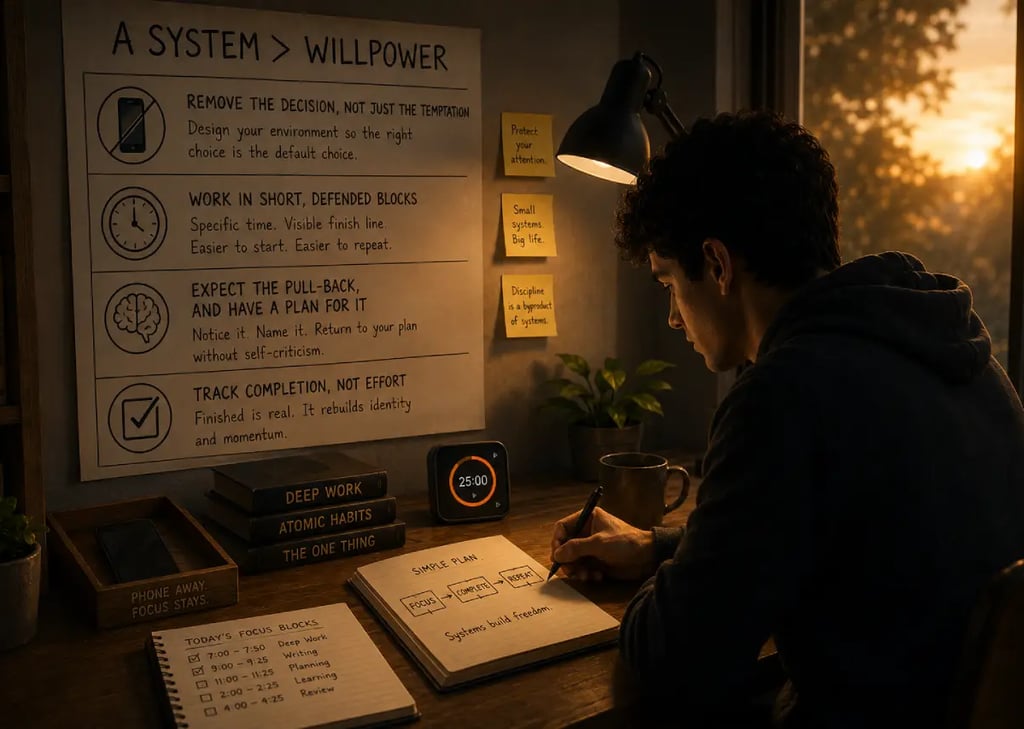
The answer isn't more motivation. It's structure — small, repeatable systems that don't depend on how strong you feel in any given moment. A few principles that actually hold up:
Remove the decision, not just the temptation. Willpower gets spent the moment you have to decide whether to check your phone. A system removes the decision entirely — phone in another room, notifications off by default, the first hour of your day pre-committed before your brain has a chance to negotiate with itself.
Work in short, defended blocks, not vague "focus time." Telling yourself "I'll focus today" is too abstract to act on. A short, specific, defended block — even five or ten minutes — gives your brain a finish line it can actually see, which makes starting dramatically easier than committing to an open-ended stretch of "productivity."
Expect the pull-back, and have a plan for it. Distraction doesn't announce itself. It shows up disguised as "just checking one thing." A real system assumes this will happen and has a built-in way to notice it and return — rather than relying on willpower to never slip in the first place, which it eventually will.
Track completion, not effort. Effort is invisible and easy to lie to yourself about. Completion is undeniable. A system built around finishing small, visible things rebuilds the part of your identity that distraction has been quietly chipping away at — the part that believes you're someone who follows through.
None of this requires more discipline. It requires a different relationship with your own attention — one built on systems instead of self-criticism.
Ready to Take Your Focus Back?
The moment you stop blaming yourself and start understanding the actual system you're up against, something genuinely shifts. You stop fighting your own mind as if it's the enemy, and start directing that same energy at the real problem — a world engineered, deliberately, to pull your attention away from what actually matters to you.
You're not broken. You were never given the training. And training is something you can still get.
That's exactly the gap The Focus Reset was built to close. Not another "try harder" book stacked with motivational language and no follow-through — a short, practical system for taking your attention back, one small reset at a time, built for people who are tired of starting strong and finishing nowhere.
Your focus isn't broken. It was just never trained. This is where that changes.
Be a Part of The Community!
Join Bold Hearts for weekly inspiring stories!
Contact
Subscribe TO BOLD HEARTS
thundermotivation007@gmail.com
© 2025. Thunder Motivation. All rights reserved.